

Casper College respects individual privacy while actively sharing the stories, achievements, and vibrant life of our campus community. Under college policy, written permission is required before using anyone’s personally identifiable information (PII) or recognizable likeness in college advertising or publicity, unless a specific exemption applies.
Quick Decision Matrix: Do you need a release?
Use this quick check before capturing or publishing any photo, video, audio recording, or personal quote:
Read the accessible text version of this decision matrix
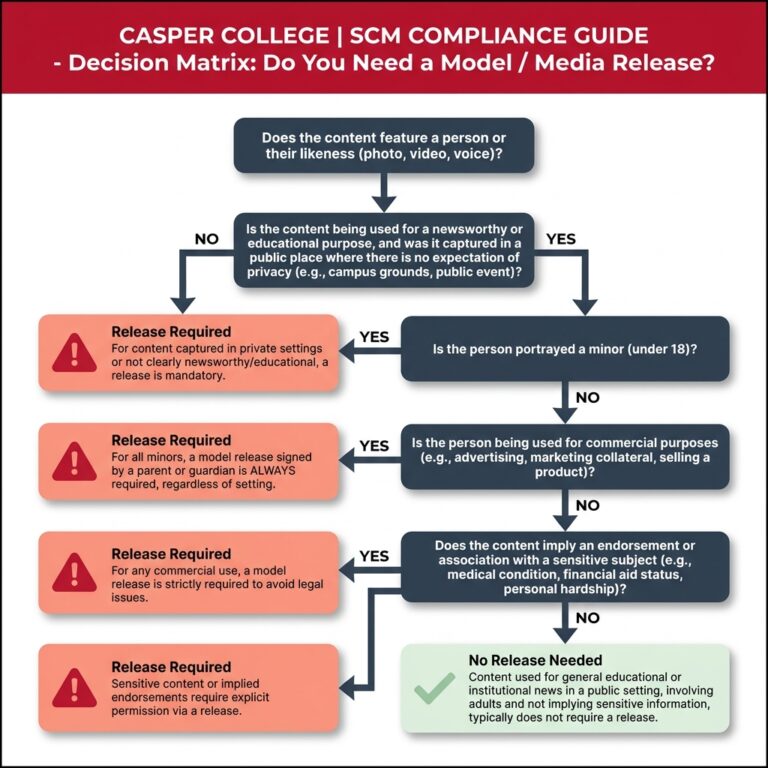
The image is a Casper College SCM Compliance Guide titled “Decision Matrix: Do You Need a Model/Media Release?” It is a flowchart designed to help determine whether a model, media, or information release is required before using content that features a person or their likeness, including a photo, video, or voice.
The flowchart begins with the question:
“Does the content feature a person or their likeness, such as photo, video, or voice?”
The chart then moves to the next decision question:
“Is the content being used for a newsworthy or educational purpose, and was it captured in a public place where there is no expectation of privacy, such as campus grounds or a public event?”
If the answer is no, then a release is required. The chart states: “Release Required. For content captured in private settings or not clearly newsworthy or educational, a release is mandatory.”
If the answer is yes, the chart continues to the next question:
“Is the person portrayed a minor, under 18?”
If the answer is yes, then a release is required. The chart states: “Release Required. For all minors, a model release signed by a parent or guardian is always required, regardless of setting.”
If the answer is no, the chart continues to the next question:
“Is the person being used for commercial purposes, such as advertising, marketing collateral, or selling a product?”
If the answer is yes, then a release is required. The chart states: “Release Required. For any commercial use, a model release is strictly required to avoid legal issues.”
If the answer is no, the chart continues to the next question:
“Does the content imply an endorsement or association with a sensitive subject, such as a medical condition, financial aid status, or personal hardship?”
If the answer is yes, then a release is required. The chart states: “Release Required. Sensitive content or implied endorsements require explicit permission via a release.”
If the answer is no, then no release is needed. The chart states: “No Release Needed. Content used for general educational or institutional news in a public setting, involving adults and not implying sensitive information, typically does not require a release.”
In summary, a release is required when content features a person or their likeness and any of the following apply: the content was captured in a private setting, the use is not clearly newsworthy or educational, the person is a minor, the content is used for commercial purposes, or the content implies endorsement or association with a sensitive subject.
A release is typically not needed when the content is used for general educational or institutional news, was captured in a public setting where there is no expectation of privacy, involves adults, and does not imply sensitive information or endorsement.
Form Location and Contact
Questions / Form Submissions: Contact Strategic Communications and Marketing at pr@caspercollege.edu or call 307-268-2372.
More Resources
Detailed Policy Exemptions
1. College Employees in the Normal Course of Employment
Applies to: Faculty teaching, staff working in offices/labs, official directory photos, job titles, office locations, and professional credentials.
Exception to exemption: If an employee is acting as a featured commercial model for a paid advertising campaign outside their normal role, best practice is to obtain written consent.
2. Public Venues and Events Where No Single Person is Dominant
Applies to: General campus scenes, open walkways, athletic games, theater audiences, campus wide-shots, graduation crowds, and open community events.
Rule of thumb: If an individual is merely part of the background or context of a public space/event, no form is needed.
3. Media and Imagery Created Directly by SCM
Applies to: Coverage captured directly by Strategic Communications and Marketing staff for institutional coverage, official news reporting, or InsideCC stories where SCM manages the release intake directly.
Common Scenarios and Action Steps
Scenario 1: Student Spotlight, Interview, or Feature Story
Rule: Release Required.
Action: Obtain a completed release form before or at the time of the interview/photo session. Verify spelling of names, major, and hometown.
Scenario 2: Classroom or Lab Photography
Group / Wide Shot (Instruction in action): No release needed if no single student is the focal point.
Close-up / Featured Student (Face in focus, recognizable subject): Release Required. Ask the student to sign the form before taking or publishing close-up photos or video.
Scenario 3: Minors on Campus (Events, Camps, Early Childhood Learning Center)
Rule: Strictly Required.
Action: Any recognizable person under age 18 must have a release signed by a parent or legal guardian prior to publication.
Scenario 4: Paid Advertising, Billboards, Brochures, and Viewbooks
Rule: Release Required for all non-employee subjects.
Action: Every recognizable student, alumnus, or community member appearing in paid digital ads, print viewbooks, direct mail, or billboards must have an active signed release on file.
Scenario 5: Social Media Takeovers & Student-Created Content
Rule: Release Required for identifiable participants.
Action: Student clubs and departments running social takeovers must ensure anyone prominently featured on camera has signed a release.
Scenario 6: Guest Speakers, Lecturers, and Visiting Artists
Public Event Coverage: General event photos do not require a release.
Recording/Broadcasting the Presentation or Using Headshot for Ads: Obtain written permission or a release covering the recording and promotional distribution.
Retention and Archiving Rules
7-Year Rule: Strategic Communications and Marketing retains signed Model/Media/Information Release forms for seven (7) years from the date of creation/distribution.
Filing Process: Departments, faculty, or staff collecting paper or digital releases must forward copies to SCM for central filing and compliance verification.
Redaction/Takedown: If a publication is found to be in violation of privacy, FERPA, or copyright rules, the post must be taken down or redacted immediately, and physical materials retrieved where possible (Policy Sec. 7.4).
Checklist for Content Creators Before Publishing
[ ] Identifiable Subjects: Are faces, names, or personal details clearly identifiable?
[ ] Exemption Check: Does this fit an official employee duty or general crowd exemption?
[ ] Form Complete: Is the release signed and dated (with parent/guardian signature if under 18)?
[ ] Scope of Use: Does the individual understand where the content will appear (web, social, print, advertising)?
[ ] FERPA & Privacy Check: Does this disclose any non-directory or protected educational records without permission?
[ ] Filed with SCM: Has a copy of the completed form been submitted to SCM?