
Economic Impact

Discover how Casper College contributes to Wyoming’s economy through workforce development, innovation and community engagement.
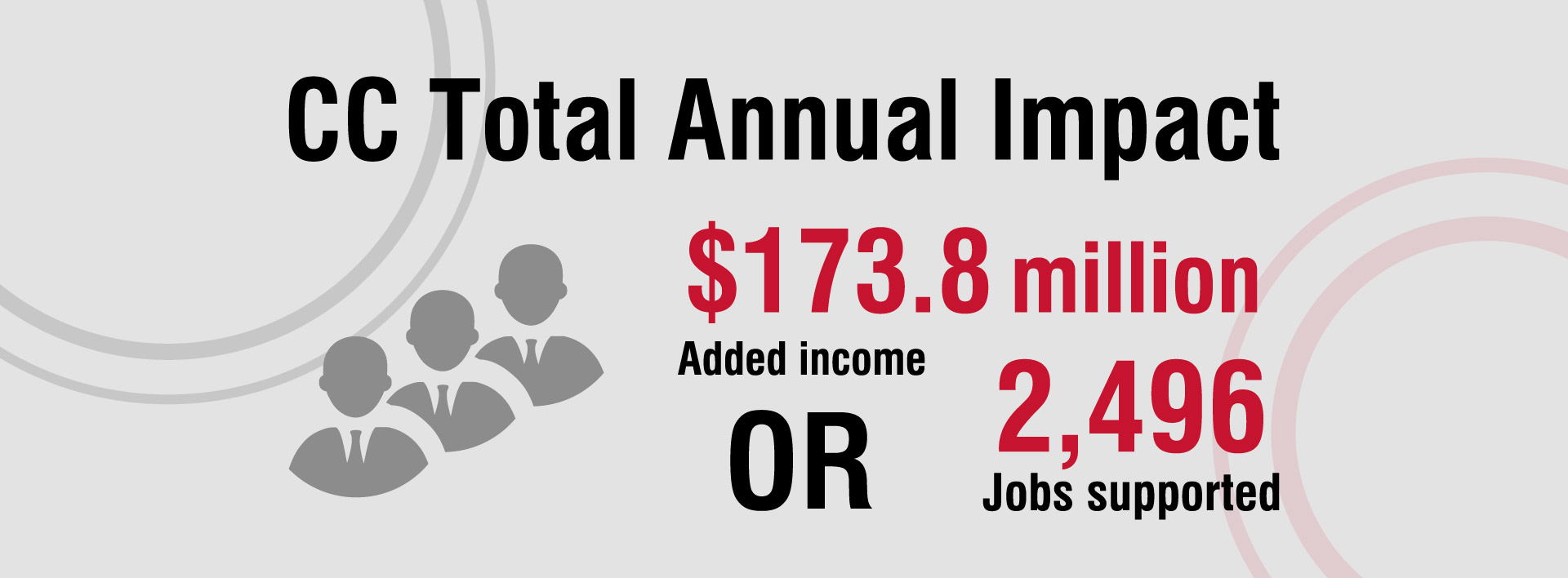
Header graphic highlighting Casper College’s total annual impact: $173.8 million in added income, or 2,496 jobs supported.

Casper College: Driving Economic Growth and Empowering Futures

At the heart of Natrona County, Casper College stands as a cornerstone of education, innovation, and economic development. For over 75 years, the college has been transforming lives, creating opportunities, and strengthening the community and state. Economic impact describes the positive contributions that Casper College, including its employees, students and alumni, have on local and regional economies. 
Economic Impact on the Community

Casper College is more than an educational institution — it’s a powerful economic engine. Every dollar invested in the college delivers a measurable return to Natrona County and Wyoming as a whole.

  • Job Creation: The college directly employs over 400 faculty and staff, and its operations support hundreds of additional jobs in the community through local spending.
  • Economic Stimulus: Students and employees contribute millions of dollars to the local economy through housing, dining, transportation, and other expenditures.
  • Workforce Development: By training a skilled workforce, Casper College meets the needs of local industries, from healthcare and technology to energy and trades. Graduates tend to stay in the area, filling critical roles and boosting productivity.
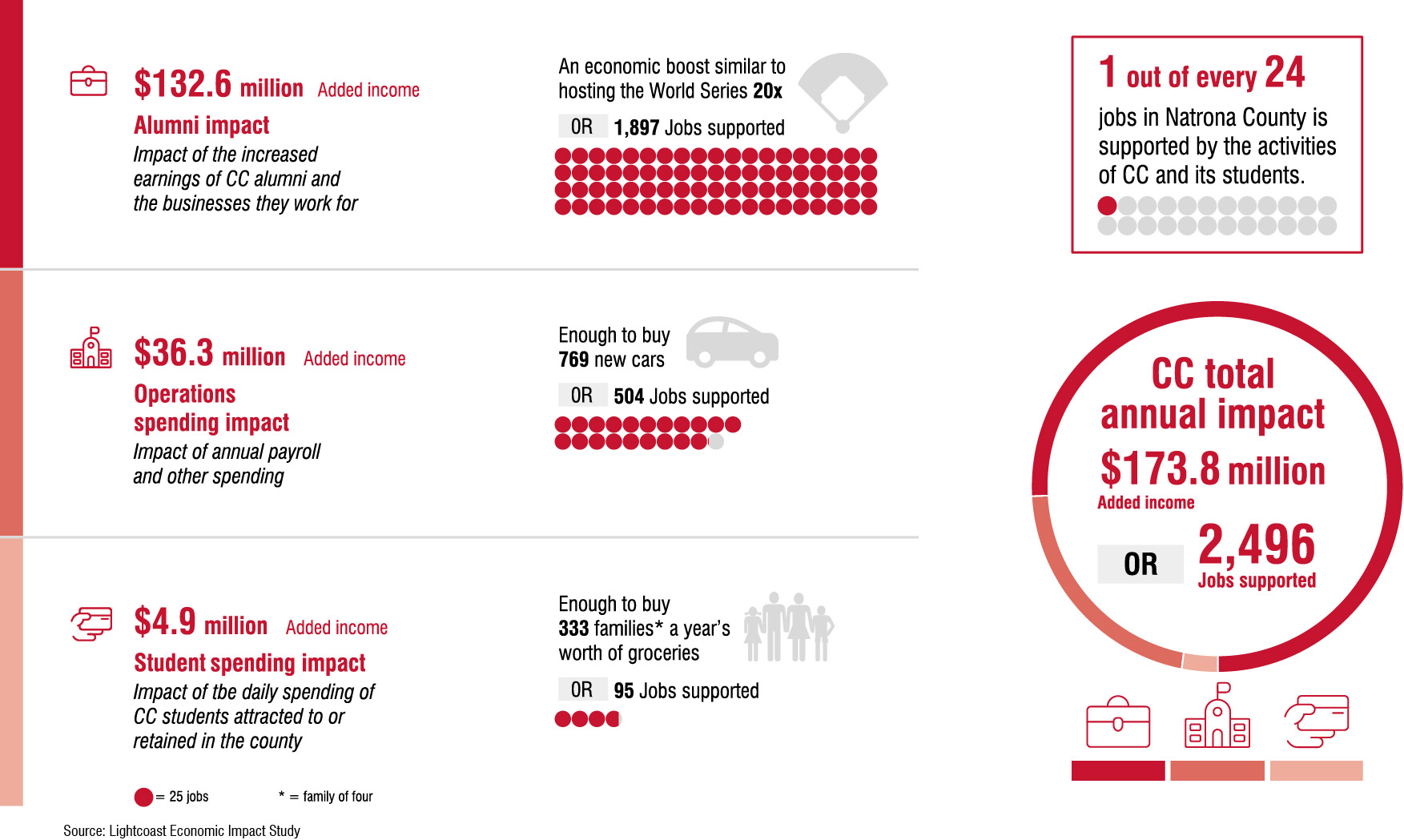
Infographic showing Casper College’s annual economic impact in Natrona County. Alumni impact adds $132.6 million in income and supports 1,897 jobs. Operations spending adds $36.3 million and supports 504 jobs. Student spending adds $4.9 million and supports 95 jobs. Total annual impact is $173.8 million in added income, or 2,496 jobs supported. One out of every 24 jobs in Natrona County is supported by Casper College and its students.

Educational Excellence for All

At the heart of Natrona County, Casper College stands as a cornerstone of education, innovation, and economic development. For over 75 years, the college has been transforming lives, creating opportunities, and strengthening the community and state. Economic impact describes the positive contributions that Casper College, including its employees, students and alumni, have on local and regional economies. 

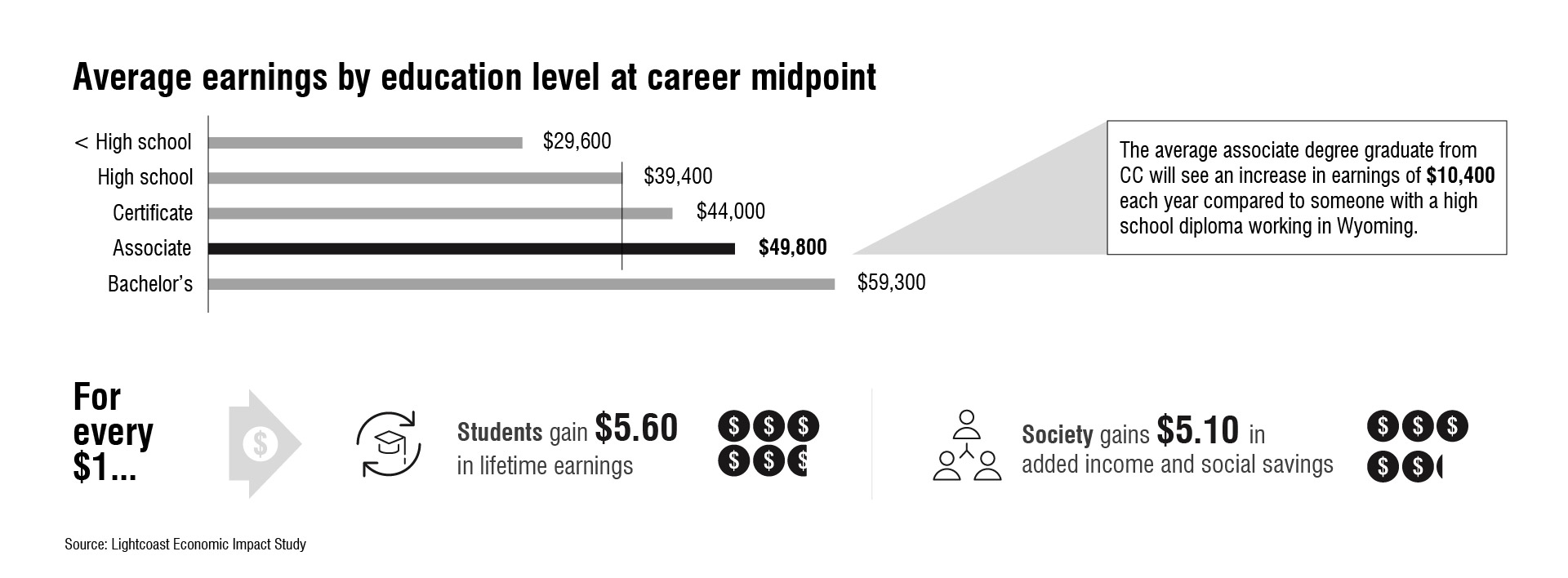
Infographic showing the economic value of a Casper College education. Average mid-career earnings by education level are $29,600 for less than high school, $39,400 for high school, $44,000 for a certificate, $49,800 for an associate degree, and $59,300 for a bachelor’s degree. The average Casper College associate degree graduate earns $10,400 more per year than someone with a high school diploma in Wyoming. For every $1 invested, students gain $5.60 in lifetime earnings and society gains $5.10 in added income and social savings.

Partnering With Industry for a Stronger Wyoming

Casper College aligns its programs with the needs of Wyoming’s economy, ensuring industries have access to a pipeline of skilled professionals.

  • Skilled Graduate Pipeline: Academic programs are continually assessed to ensure they meet current labor demands and address future opportunities.
  • Career and Technical Education, or CTE, programs: equip students with the career-ready knowledge and practical skills needed for high-demand careers across various industries.
  • Workforce Development: offers programs designed to meet Wyoming’s evolving economic needs, providing specialized training and certifications that support the state’s workforce growth.
  • Business Collaboration: Partnerships with local employers provide internships, apprenticeships, and job placements that give students real-world experience and a competitive edge.
  • Business and Industry Leadership: Business and industry programs gain from the insights, advice, and leadership of business leaders in the region, which helps ensure programs are aligned with their evolving needs.

Economic Impact on the Community

Casper College is woven into the fabric of Natrona County, offering cultural enrichment, lifelong learning opportunities, and public resources.

  • Cultural Events: The college hosts speakers, events, art exhibitions, theater productions, and concerts that bring the community together.
  • Public Services: Casper College serves as a resource for the entire region.
    • Community Education programs offer training and educational courses that enhance skills, support career growth, and foster lifelong learning.
    • BOCES dual and concurrent courses allow high school students to jumpstart their college education and earn college credit that they can apply toward a degree.
    • Osher Lifelong Learning Institute, OLLI at Casper College, supports intellectual curiosity and community enrichment for adults 50+.
    • The Lee and Felicia Castellow Adult Learning Center provides free assistance to out-of-school adult students who need to improve their basic reading, writing, and math skills in preparation for their high school equivalency certificate.
  • Youth Enrichment Programs:
  • Library and Museums:
    • Goodstein Foundation Library has more than 70,000 print volumes. It offers digital access to over 200 databases, 680,000 ebooks, and 100,000 journals.
    • Western History Center has published digital materials for over 180 collections and almost 7,000 items. The Western History Center also has more than 400 collections.
    • The Werner Wildlife Museum connects the community with Wyoming’s rich natural heritage.
    • The Tate Geological Museum, a regional earth science education center, offers educational exhibits and programs for all ages. The museums serve as important community and educational resources.

Volunteerism and Service

Casper College employees give back to the community through their contribution of thousands of hours to local initiatives and service learning projects.
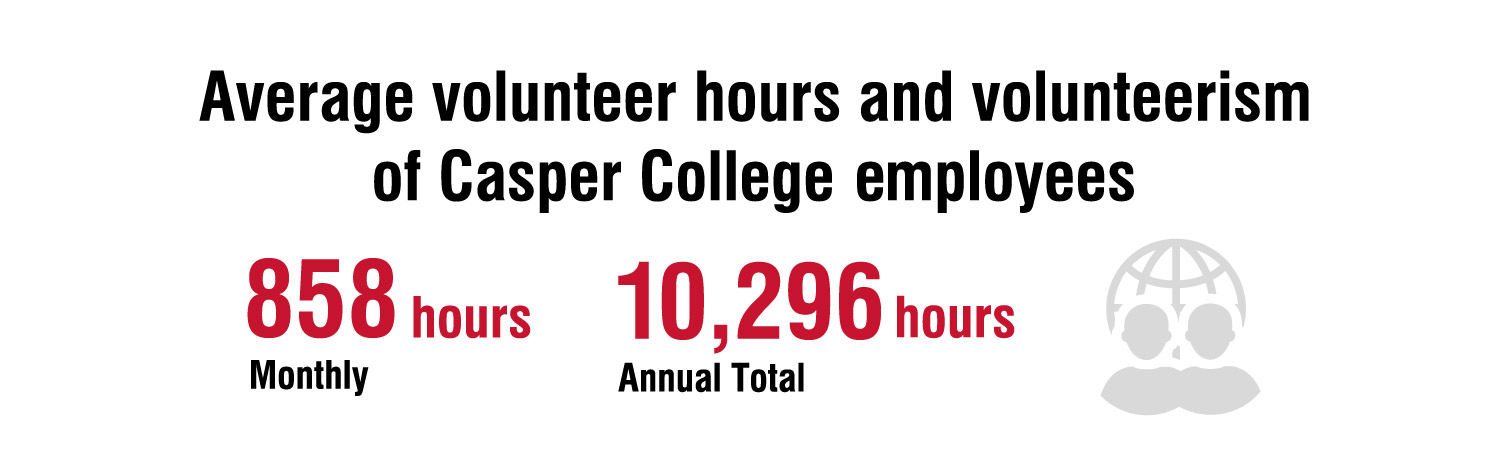
Graphic showing average volunteer hours by Casper College employees. Employees volunteer an average of 858 hours monthly, totaling 10,296 volunteer hours annually.

This is a current notification for everybody viewing the site