

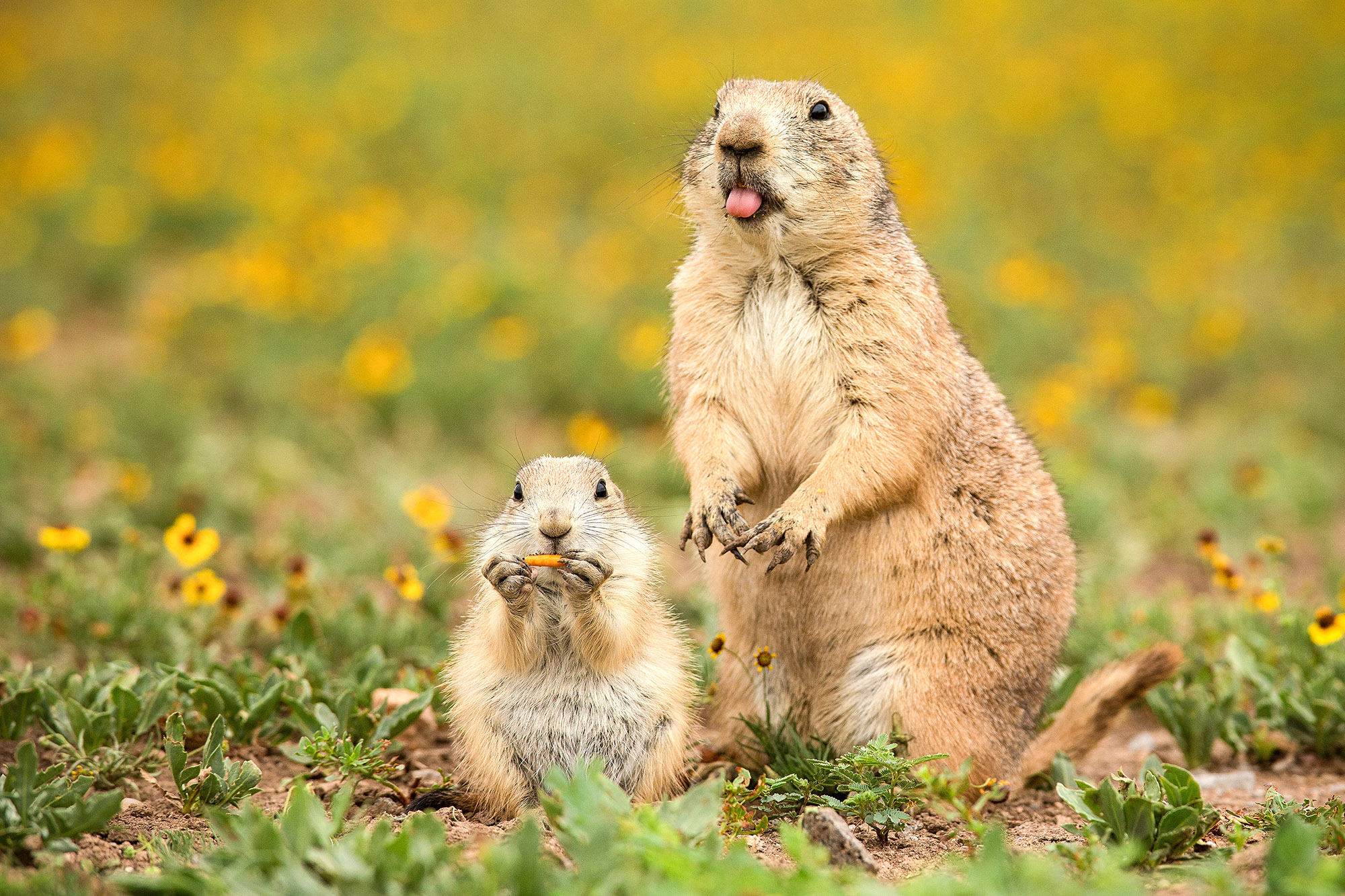
Wildlife enthusiasts are encouraged to learn about prairie dog disease dynamics at the Oct. 28 Wildlife Study Series event at the Werner Wildlife Museum beginning at 6 p.m.
Research Presented at the Wildlife Study Series
University of Wyoming graduate student Joel Sorensen will give a presentation titled “Studying Scale-Dependent Disease Dynamics in Prairie Dogs.” Sorensen is a master’s student in zoology and physiology in the Barrile Lab at UW, working under Dr. Gabe Barrile.
“My research focuses on understanding the dynamics of sylvatic plague in black-tailed prairie dogs across three spatial scales: individuals, colonies, and grasslands,” said Sorensen. According to Sorensen, prairie dogs offer an ideal system for studying scale-dependent disease dynamics because they inhabit a natural social and spatial hierarchy.
Family groups called coteries form colonies that often cluster into connected networks across grasslands. “This structure allows me to investigate how individual traits and colony-level processes scale up to drive regional plague outbreaks, which can cause mortality exceeding 95%,” he said. “Because prairie dogs are a keystone species — serving as prey for many predators and creating habitat for numerous grassland species — plague outbreaks can have cascading ecological impacts,” Sorensen added. Sylvatic plague is caused by the bacterium Yersinia pestis and transmitted by fleas.
Sorensen’s research integrates long-term spatial data with field-based disease monitoring. “I am analyzing 20 years of annual prairie dog colony maps from nine grasslands across the Western Great Plains to examine how colony size, configuration, and connectivity relate to plague occurrence.” At the grassland scale, Sorensen used landscape metrics, including colony area, density, edge density, and aggregation, along with climate variables such as precipitation, temperature, and drought indicators to investigate regional factors that influence plague outbreaks.
Spatial Hierarchy and Plague Dynamics in Grassland Ecosystems
“At the colony scale, I apply network analyses to evaluate how spatial connectivity among colonies may facilitate plague transmission. At the individual scale, I am conducting capture-mark-recapture surveys in Thunder Basin National Grassland in eastern Wyoming to collect data on population density, age structure, reproduction, body condition, and flea load,” Sorensen said.
By linking individual health and demographic patterns to colony connectivity and landscape structure, Sorensen’s research aims to clarify how small-scale processes shape large-scale disease dynamics. “Ultimately, my goal is to provide wildlife managers with tools to better predict when and where plague outbreaks are likely to occur and to improve the efficiency of plague mitigation efforts,” he said.
The Werner Wildlife Museum hosts the Werner Wildlife Study Series in the Africa-Arctic Room. The family-friendly event is free and open to the public. For more information, call 307-235-2108.
The Werner Wildlife Museum, located off the Casper College campus at 405 E. 15th Street, is free and open Monday through Friday from 10 a.m. to 4 p.m.
At a Glance:
- Event Focus
- Presentation Title: “Studying Scale-Dependent Disease Dynamics in Prairie Dogs”
- Exploration of scale-dependent sylvatic plague dynamics and flea-borne transmission across black-tailed prairie dog colonies in Western grasslands
- Key Participants
- Speaker: Joel Sorensen, University of Wyoming master’s student in zoology and physiology, Barrile Lab
- Research Advisor: Dr. Gabe Barrile, University of Wyoming
- Host: Werner Wildlife Museum
- Logistics: Dates, Times, and Locations
- Date: Wednesday, Oct. 28, 2026
- Time: 6 p.m.
- Location: Africa-Arctic Room, Werner Wildlife Museum, 405 E. 15th Street, Casper, Wyoming
- Admission and Registration
- Admission: Free and open to the public
- Family-friendly event with no advance registration required
- Contact: 307-235-2108